Multiple multipliers
2009-01-25 · Original WordPress address
Gali's paper is really good. Its the best case for fiscal policy I've seen using the modern macro framework. I think the introduction and conclusion are accessible to a general audience and the empirical and modeling sections are good reviews of new Keynesian models and methods for you macro geeks.
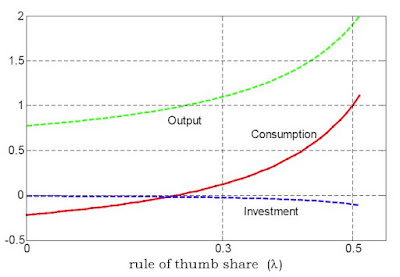
Anyway, the model's innovation is this chart (particularly the increase in consumption due to government expenditure):
The greek symbol lambda represents the percentage of the population that live hand-to-mouth. These are folks that eat everything they earn; they don't save. The model is agnostic as to why these folks make decisions like this, i.e. limited access to credit markets, myopia, etc. On the vertical access, you see the multipliers implied by each level of hand-to-mouthers. To get multipliers above one --- to make government spending worth it --- less than 75% of the population needs to be savers. Christie Romer's multiplier of 1.5 corresponds to having about 40% of the population living paycheck to paycheck.
I'll leave it to the reader to decide what lambda is reasonable.
What's the mechanism, you ask?
Rule-of-thumb consumers [wa: i.e. non-savers] partly insulate aggregate demand from the negative wealth effects generated by the higher levels of (current and future) taxes needed to finance the fiscal expansion, while making it more sensitive to current disposable income. Sticky prices make it possible for real wages to increase (or, at least, to decline by a smaller amount) even in the face 29 of a drop in the marginal product of labor, as the price markup may adjust sufficiently downward to absorb the resulting gap. The combined effect of a higher real wage and higher employment raises current labor income and hence stimulates the consumption of rule-of-thumb households. The possible presence of countercyclical wage markups (as in the version of the model with non-competitive labor markets developed above [wa: and represented by the graph above]) provides additional room for a simultaneous increase in consumption and hours and, hence, in the marginal rate of substitution, without requiring a proportional increase in the real wage.
Non-savers don't save even though they know their taxes will be higher in the future. So when government expenditures increase employment and price stickiness keeps real wages high, the non-savers consume more.
Good stuff.