"My beef with Scott Sumner" OR "Dude, you've already won the debate!"
2010-01-25 · Original WordPress address
Pleasantries: brilliant blog. Anyone remotely interested in monetary policy, a.k.a. "the only remotely possible technocratic method to manage an economy", should read it.
Ok. Prof. Sumner is absolutely right that the Fed made a mistake in fall of 2008. This is illustrated by the sharp decline in inflation expectations as illustrated in this graph (stolen from here):
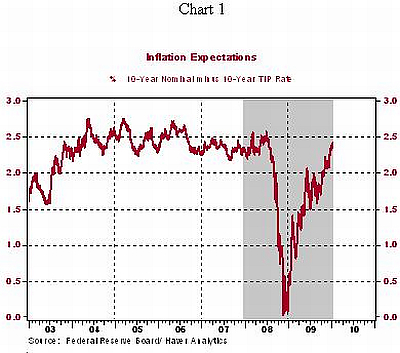 But Sumner often slips from this valid critique into a claim that the Fed continues to make a mistake (e.g. here: "Throughout much of 2009 I kept challenging liberals to push harder for monetary stimulus."). This is not a valid argument. For example, the Fed made a mistake in the late 1920's trying to prick what they thought was a stock bubble. Their actions helped precipitate the Great Depression. Flippantly: this doesn't mean policy is still too tight today. More relevantly: its not the reason why policy was too tight in 1930, 1931, 1932 and early 1933. The mistakes they made in those years where independent of the original mistake.
The sharp up-tick in inflation expectations through 2009, as seen in the graph above, suggests the Fed is no longer making a mistake; policy is no longer too tight.
What to do about high unemployment (illustrated below)?
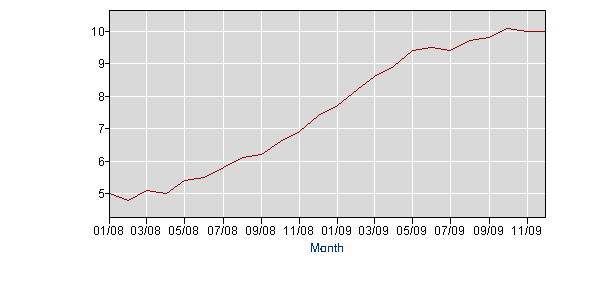 First, unemployment has --- hopefully! --- topped out. This is more evidence that policy is, if not appropriately loose, at least loosening. Second, we don't know the mechanisms linking macro policies to employment. The Fed doesn't (and can't!) determine the unemployment rate in any given month even if completely ignored inflation. Its hubris to suggest that it can. Third, even if money policy's effects on inflation expectations is immediate, in a world of very slow moving wages, there's long lags between policy changes and employment changes. The current policy could be producing improvements in the unemployment rate maybe today, maybe in three months, maybe in nine months... we don't know.
All this said, I support Sumner's goal of moving the Fed towards history dependent policy (aka "level targeting"). This policy, if even implementable, would make mistakes like the one the Fed made in fall 2008 less severe. I'm just not sure why Prof. Sumner insists on arguing policy is still too tight today, nearly 16 months later, when he doesn't need to in order to make a case for this policy change.