Why a good "policy stance" might matter
2010-01-11 · Original WordPress address
I haven't read John Taylor's newest working paper yet, but its about the Fed's start-stop policy stance under the ancien régime. The story he's riffing on in that paper is pretty standard. There was high and variable inflation under the old monetary policy regime because the Fed didn't fully accept its role in determining inflation. It would have moments of commitment to fighting unemployment or the output gap and so it would loosen policy. When inflation came, they'd commit to lowering inflation. They'd tighten policy long enough to induce a contraction in output, but not long enough to re-anchor inflation expectations at lower rates. Rinse and repeat. Stagflation and uncertainty.
Then Volker came and saved the day!
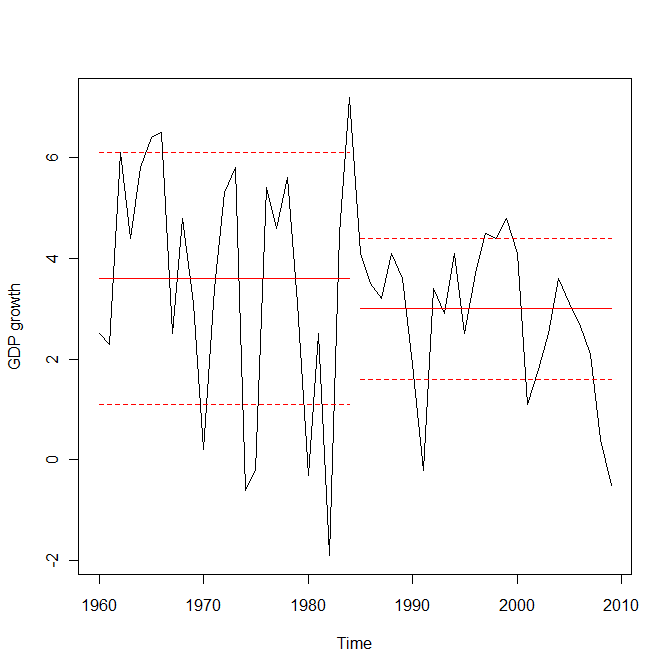 The Great Inflation is the time before 1985 and the Great Moderation is the time after. I've labeled the regime average and standard deviations.
I'm not interested in debating the reasons for the Great Moderation starting in the mid-80s, but at least one reason for the decrease in volatility in both output and inflation is that the policy stance of the Fed changed. It gained credibility as an inflation stabilizer. It was going to set an (implicit) inflation target and do what it needed to hit it.
Compare the 25 years before 1985 to the 25 years after. The old regime saw 5 recession, the new regime only three (and two of those were pretty mild). As you can see in the graph (which includes the most recent recession), volatility of output decreased. Similarly, volatility of inflation and consumption also decreased. As Bernanke pointed out in his Great Moderation speech, these trends are evident in other countries as well.
The thing that changed was the adoption of a confident and credible policy stance by Central Banks around the world. They woke up to their power to control inflation. And Bernanke was trying to wake up the Bank of Japan to its power as an effective manipulator of inflation; to build their confidence. Central Banks also learned the power of credibility. And this is why Bernanke responded to Delong's question the way he did.