The unemployed aren't the only ones seeking jobs
2010-03-03 · Original WordPress address
Work with me here. In normal times, say 2004 through 2007, suppose 10% of the working population are looking for jobs while still employed (do you know of a better estimate?). This means about 13 to 14 million employed workers are "job seekers" in normal times.
"Quits" are voluntary separations from jobs and folks do that because they're leaving the work force (e.g. retiring) or because they found another job. Now look at quit rates over the last couple of years:
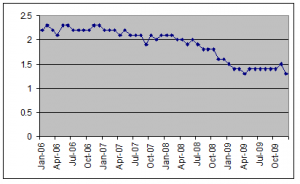 Quits have declined by about 40% compared to normal times. From here, about 50% of quits are retirements. If the retirement rate has stayed the same, then quits due to job changes went from 1.1% to about 0.5%. This suggests the number of "job seekers" among the employed has gone down by at least half.
How many job seekers are there right now? Supposing all unemployed workers are "job seekers" then the total number is about 20 million people. In normal times, that number is about... 21 or 22 million people (unemployed plus 10% of the working population). By this measure, the job market now is less congested than usual!
Making the assumptions that I made above, I constructed a "job seekers" per job opening time series:
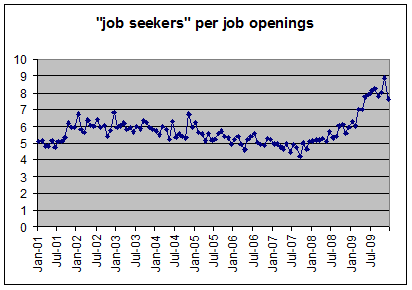 If you assume none of the currently employed workers are "job seekers" then the graph above looks like the one put up by EPI. If you assume 20% of the currently employed are "job seekers" then even the up-tick seen in the later part of the time series goes away.